
What is scarring alopecia?
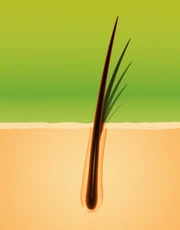
In most hair loss, the follicles survive and hair can regrow. In scarring alopecia, the follicles themselves are damaged beyond repair. The skin in the affected patches becomes smooth and shiny, and the tiny openings where hairs grew disappear.
These conditions are uncommon, and they often start quietly: a patch of itching, burning or redness, or hair thinning in one area. That’s why a scalp that keeps flaring up with hair loss should always be checked.
The short answer
Scarring alopecia, also called cicatricial alopecia, is a group of conditions in which inflammation destroys hair follicles and replaces them with scar tissue, so hair can’t grow back in those areas. The commonest types are lichen planopilaris, frontal fibrosing alopecia, discoid lupus and CCCA. Early diagnosis by a dermatologist matters, because treatment can stop it spreading.
Signs of scarring alopecia
- Patches of hair loss where the skin looks smooth, shiny or paler
- Redness, scale or crusting around the hairs at the edge of a patch
- Itching, burning, tenderness or pain
- Patches that slowly grow larger
- Several hairs growing from one opening (tufting)
- No short regrowing hairs inside the patch
Some scarring alopecias are very inflamed and sore; others cause almost no symptoms and are only noticed when a bald patch appears.
Smooth bald patches without redness or scarring are more often alopecia areata, where hair can regrow. Telling the two apart needs a close look and often a biopsy.
Types of scarring alopecia
Each type has its own pattern and treatment, which is why an accurate diagnosis comes first.
Lichen planopilaris
An inflammatory condition causing redness and scale around the hairs, itching and burning, and patches of loss, often on the crown.
Frontal fibrosing alopecia
A form of lichen planopilaris that makes the front hairline recede, often with eyebrow loss. Frontal fibrosing alopecia.
Discoid lupus
Red, scaly, disc-shaped patches that can scar and change skin colour. Sunlight can make it worse, so sun protection matters.
Central centrifugal cicatricial alopecia
CCCA starts at the crown and spreads outwards, mostly in women of African descent. It isn’t simply caused by hairstyles, and early treatment helps.
Folliculitis decalvans
Repeated crops of pustules that destroy follicles, often with tufting. Scalp folliculitis.
Dissecting cellulitis
Painful, deep, joined-up lumps on the scalp, most often in young men.
Pseudopelade of Brocq
Pseudopelade of Brocq is a rare, slowly progressive scarring alopecia. It causes small, smooth, irregular patches of hair loss, often on the crown, with very little redness or scale. The patches have been described as looking like footprints in the snow.
Because there’s so little inflammation, it’s easily missed or mistaken for alopecia areata. Many specialists now see it as the late, burnt-out stage of other scarring alopecias, such as lichen planopilaris, so a dermatologist will usually take a biopsy to find out which.
Pseudopelade of Brocq treatment aims to stop new patches forming, and depends on what the biopsy shows. Hair already lost doesn’t regrow, but the condition often progresses slowly, and many people keep most of their hair.

Scarring alopecia diagnosis and treatment
Scarring alopecia is diagnosed and treated by a dermatologist. A small skin sample (biopsy) is often needed to confirm it and to find out which type it is, because the treatments differ.
- The aim is to stop it spreading and calm symptoms such as itching and burning. Lost hair doesn’t regrow.
- Medicines to calm inflammation, such as steroid creams or injections, or tablets, depending on the type.
- Sun protection for discoid lupus and for scarred skin, which burns easily.
- Hair transplants are sometimes possible once the condition has been inactive for a long time.
- Camouflage, from styling and toppers to scalp micropigmentation, can make a real difference.
How I can help
Early signs of scarring alopecia are easy to miss. At a consultation in Forest Row I examine your scalp closely, ask about your symptoms and how the patches have changed, and look for the signs that need a dermatologist.
If I suspect scarring alopecia, I’ll write to your GP to ask for an urgent dermatology referral. Alongside your dermatologist, I can help with scalp care, comfort and ways to make the most of your hair. What happens at a consultation.
When to see your GP first
Please see your GP or call NHS 111 if:
- your hair loss came on suddenly and you feel unwell
- your scalp is very painful, swollen, weeping or bleeding
- you have patches of hair loss with redness or scarring that are spreading quickly
- you think a new medicine may be the cause. Don’t stop it without speaking to your doctor
You can still see me as well. I’ll happily liaise with your GP if further tests are needed.
Questions about scarring alopecia
If yours isn’t here, send me a message and I’ll get back to you.
Can hair grow back after scarring alopecia?
Not where the follicles have been destroyed. Treatment aims to stop the condition spreading, so the earlier it starts, the more hair you keep.
Is scarring alopecia the same as alopecia areata?
No. Alopecia areata doesn’t destroy the follicles, so hair can regrow. Scarring alopecia does, which is why telling them apart early matters.
What does discoid lupus on the scalp look like?
Red, scaly, round patches that can become scarred, with hair loss and sometimes lighter or darker skin. Sunlight often makes it worse.
Is lichen planopilaris serious?
It isn’t dangerous to your health, but it can cause permanent hair loss, so it should be treated by a dermatologist as early as possible.
Do I need a biopsy for scarring alopecia?
Usually, yes. A small biopsy confirms that the hair loss is scarring and shows which type it is, which guides treatment.
Let’s find out what’s going on
Book online at a time that suits you. If you have a question first, send me a message.