Why does menopause affect your hair?
A thinner ponytail, a parting that seems wider, hair that has suddenly turned dry and wiry: these are some of the changes women most often bring to me around the menopause. They’re common, and they’re upsetting, especially when everything else is changing too.
Oestrogen helps keep hair in its growing phase. As levels fall, the balance shifts towards androgens, and in women who are prone to it this brings out female pattern hair loss, a gradual thinning on top of the head. Falling oestrogen also makes hair and scalp drier.
Not sure the menopause is the cause? Hair loss in women explains the other common causes.
The short answer
As oestrogen falls around the menopause, hair follicles that are sensitive to androgens are affected more, so hair on top can thin and lose volume, and it often turns drier and coarser. Menopause isn’t the only cause at this age, though: shedding, thyroid problems and low iron can look the same, so it’s worth finding out which it is.
Perimenopause, menopause and after
Your hair can change at every stage, and knowing where you are helps make sense of it.
Perimenopause hair loss
Hair changes often start in perimenopause, years before your periods stop, as hormones rise and fall. You may notice months with more shedding, a parting that looks wider, or hair that won’t hold a style.
Menopause
You reach the menopause 12 months after your last period; in the UK the average age is 51. Thinning on top is most often noticed around now. An early or surgical menopause can bring changes on faster.
Hair loss after menopause
In the years that follow, female pattern thinning can carry on slowly, and hair texture keeps changing. A receding hairline or eyebrow loss after the menopause needs checking early (see below).
What else could it be?
Several causes of hair loss are common at this age, and they often overlap. Each needs something different.
Female pattern hair loss
The most common reason for thinning on top at this age. The menopause often reveals an inherited tendency to thinning that was already there.
Shedding
Stress, illness, an operation or a change in diet can trigger heavy shedding a few months later, and midlife brings plenty of all four.
Thyroid problems
Thyroid symptoms such as tiredness, weight change and low mood overlap with the menopause, so it’s easy to miss. A blood test answers it.
Low iron and vitamins
Low iron stores, vitamin D or B12 can add to thinning. Test first rather than guessing with supplements.
Frontal fibrosing alopecia
A slowly receding hairline, often with eyebrow loss, mostly in women after the menopause. It causes permanent loss, so see someone early.
Scalp problems
A dry, itchy or sore scalp is common as oestrogen falls, and scalp conditions such as seborrhoeic dermatitis can flare.
Why your hair feels different
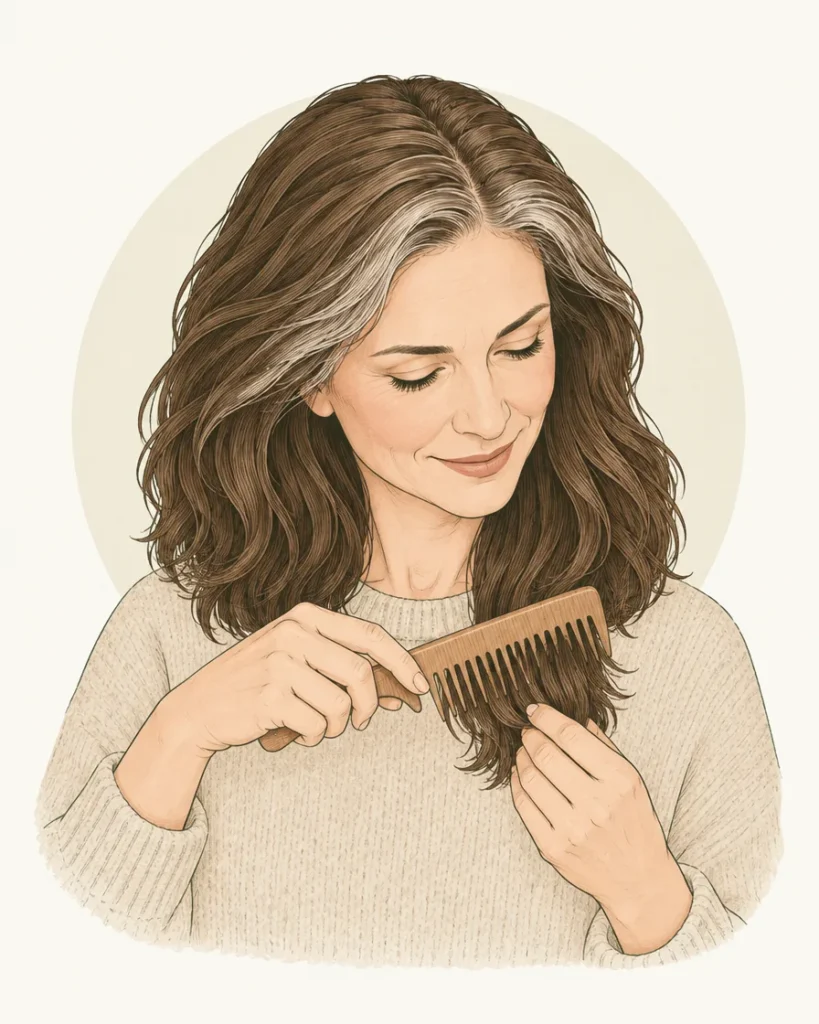
Many women find their hair turns drier, coarser or wiry around the menopause, with more frizz and less shine. Grey hairs can behave differently too.
You can’t stop these changes, but you can make your hair easier to live with:
- Condition every time you wash, and use a hydrating mask once a week.
- Keep heat tools below about 180°C, use a heat protectant, and let hair cool before brushing.
- Choose soft bands and looser styles, and vary where you tie your hair.
- Have regular trims, so split ends don’t travel up the hair.
- For Afro-textured hair, detangle before washing, layer moisture and rotate protective styles to protect your edges.
Does HRT help menopause hair loss?
HRT can help some women’s hair, and by easing hot flushes and poor sleep it helps how you feel overall. But it isn’t a hair loss treatment on its own, and it won’t stop female pattern hair loss.
The type matters. Some HRT and contraceptive pills contain progestogens that act a little like androgens, and in women who are prone to thinning these can make it worse. Others are more hair-friendly. If your hair changed after starting or switching HRT, tell me and your prescriber.
Please don’t start, stop or change HRT for your hair without your doctor. I can write to your GP or menopause specialist so the decision takes your hair into account. If you can’t or don’t want to take HRT, there are non-hormonal options.
Menopause hair loss treatment
Treatment depends on the cause, so a diagnosis comes first.
- Female pattern thinning can often be slowed, and sometimes improved, with treatments such as topical minoxidil.
- Shedding usually settles once the trigger is dealt with, though regrowth takes months.
- Low iron, vitamins or thyroid problems are put right with your GP, and your hair follows.
- Frontal fibrosing alopecia needs early referral to a dermatologist, to protect the hair you have.
- A dry or sore scalp settles with the right routine, which gives any treatment a better chance.
Hair grows about a centimetre a month, so give any treatment six months or more before you judge it.
How I can help
At a consultation in Forest Row we spend about an hour together. I examine your hair and scalp closely and take a full history, including where you are in the menopause, your periods, HRT, contraception, diet and anything that has happened in the last few months.
Please bring the names and doses of any medicines, HRT and supplements you take. Blood tests aren’t always needed; if they are, I’ll explain which ones and how to get them. You leave with a clear explanation and a written plan made for you.
When to see your GP first
Please see your GP or call NHS 111 if:
- your hair loss came on suddenly and you feel unwell
- your scalp is very painful, swollen, weeping or bleeding
- you have patches of hair loss with redness or scarring that are spreading quickly
- you think a new medicine may be the cause. Don’t stop it without speaking to your doctor
You can still see me as well. I’ll happily liaise with your GP if further tests are needed.
Questions about menopause hair loss
If yours isn’t here, send me a message and I’ll get back to you.
Does hair grow back after menopause?
It depends on the cause. Shedding usually recovers. Female pattern thinning won’t reverse on its own, but treatment can often slow it and sometimes improve density.
Is menopause hair loss permanent?
Usually not completely. Most menopause hair loss is thinning rather than bald areas, and much of it can be helped. Scarring hair loss, such as frontal fibrosing alopecia, is the exception.
Is hair loss in perimenopause normal?
It’s common, as fluctuating hormones can bring more shedding and thinning. Common doesn’t mean you have to put up with it, and it’s worth ruling out thyroid problems and low iron.
Can menopause cause eyebrow hair loss?
Eyebrows can become sparser with age, but noticeable eyebrow loss, especially with a receding hairline, can be a sign of frontal fibrosing alopecia or a thyroid problem. Get it checked.
Which vitamins help menopause hair loss?
Only the ones you’re low in. Have your iron stores, vitamin D and B12 tested first; taking supplements you don’t need won’t help your hair.
Does HRT make hair loss worse?
Usually not, but some types of HRT can aggravate thinning in women who are prone to it. Speak to your prescriber before changing anything.
Let’s find out what’s going on
Book online at a time that suits you. If you have a question first, send me a message.